Table of Contents:
ToggleIntroduction
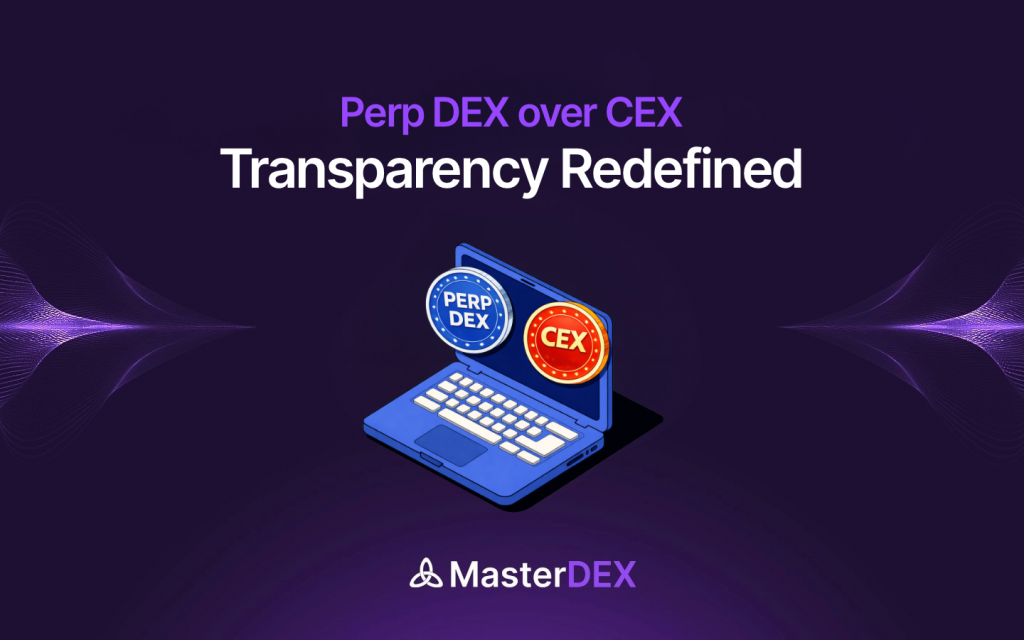
As crypto markets mature, traders are no longer impressed by speed alone. Transparency, verifiability, and control are becoming equally important, especially in high-risk products like perpetual futures. This shift in priorities is driving a growing preference for Perp DEX over CEX, as decentralized perpetual exchanges offer a fundamentally different approach to how markets operate.
While centralized exchanges once dominated perpetual trading, their trust-based systems are increasingly being questioned. In contrast, Perp DEXs are built on open infrastructure, where the rules are visible, execution is verifiable, and custody remains with the trader. This structural difference is why transparency has become a defining advantage for decentralized perpetual trading.
The Transparency Problem With Centralized Exchanges
Centralized exchanges have long been the default choice for perpetual trading. They are fast, liquid, and familiar. However, their biggest weakness lies in how much traders are expected to trust systems they cannot see.
On a CEX, core processes such as order matching, liquidation logic, margin calculations, and risk management are handled internally. Traders only see the final outcome of these processes, not how decisions are made behind the scenes. When a position is liquidated or funding rates change abruptly, there is often no independent way to verify whether those actions followed consistent or fair rules.
This lack of visibility becomes especially risky in leveraged markets. Perpetual trading amplifies exposure, meaning even small inconsistencies or hidden mechanics can have outsized consequences. During periods of high volatility, traders may experience unexpected liquidations or price wicks without clear explanations.
The issue is not necessarily malicious intent. Rather, the centralized model itself relies on trust in a single entity. When transparency is limited, confidence erodes, particularly after repeated industry incidents that exposed how fragile trust-based systems can be. This growing awareness has pushed traders to question whether convenience alone is worth the opacity.
What Makes Perp DEXs Fundamentally Different
Perpetual decentralized exchanges are designed with a completely different philosophy. Instead of trusting an operator, traders interact directly with smart contracts deployed on public blockchains. This architectural shift is central to why Perp DEX over CEX is gaining traction.
On a Perp DEX, execution rules are encoded into smart contracts. These rules define how trades are placed, how margins are calculated, and how liquidations occur. Because this logic is on-chain, it can be inspected and verified by anyone. There is no hidden matching engine or discretionary intervention.
Custody is another major distinction. Traders do not deposit funds into an exchange-controlled wallet. Instead, they trade directly from their own wallets, interacting with protocols that enforce rules automatically. This self-custodial setup removes a major layer of counterparty risk that exists on centralized platforms.
Market data is also handled differently. Metrics such as open interest, funding rates, and liquidation events are derived from on-chain activity. Rather than trusting reported numbers, traders can rely on verifiable data. In the broader discussion of perpetual DEX vs centralized exchange transparency, this openness represents a structural advantage rather than a feature toggle.
Perp DEX Over CEX: Transparency at Every Layer
One of the strongest arguments for Perp DEX over CEX is that transparency is not limited to a single component; it exists across every layer of the trading process.
At the execution level, trades follow publicly defined rules. There is no ambiguity around how prices are sourced or how orders are processed. Every transaction is recorded on-chain, making it possible to audit execution independently.
Liquidations, often a point of contention on centralized exchanges, are fully transparent on Perp DEXs. The conditions that trigger liquidations are predefined, and when they occur, the data is visible on-chain. Traders can see exactly why a position was liquidated, reducing suspicion and uncertainty.
Funding rates and fees are equally transparent. Calculations are based on observable market data and applied through smart contracts. This eliminates unexpected adjustments and provides clarity on how costs accumulate over time.
By removing hidden mechanisms, Perp DEXs reduce information asymmetry. Traders are no longer dependent on exchange communications or post-event explanations. Instead, they operate in an environment where outcomes can be verified in real time, reinforcing confidence in the system.
Self-Custody and On-Chain Data: A Major Advantage
Self-custody is one of the most practical and philosophical advantages in the Perp DEX over CEX comparison. When traders retain control of their assets, they are not exposed to withdrawal freezes, account restrictions, or platform-level custody risks.
This control becomes particularly valuable during volatile market conditions. On centralized exchanges, operational decisions can directly impact user access. Perp DEXs eliminate this dependency by allowing traders to interact directly with protocols, not intermediaries.
On-chain data further strengthens this model. Because all activity is recorded on the blockchain, traders gain access to real-time information on positions, open interest, funding rates, and liquidations. This transparency supports more informed decision-making, especially for traders who rely on data-driven strategies.
Platforms like MasterDEX help surface this on-chain information by aggregating data across decentralized markets, making it easier for traders to monitor perpetual activity without sacrificing transparency. This improves usability while preserving the core principles of decentralization.
From a time-horizon perspective, Perp DEXs offer value on both fronts. In the short term, active traders benefit from predictable liquidation rules, transparent funding mechanics, and real-time visibility features that reduce execution uncertainty during volatile periods.
In the long term, the advantages compound. Self-custody, open infrastructure, and protocol-level transparency create a sustainable trading environment aligned with the future direction of decentralized finance.
Conclusion: Transparency Is Becoming the New Standard
The rise of Perp DEX over CEX is not driven by ideology alone; it is a response to real structural shortcomings in centralized systems. As traders become more sophisticated, they demand environments where outcomes can be verified, not just trusted.
Centralized exchanges still offer speed and convenience, but their opaque mechanics and custody risks limit long-term confidence. Perp DEXs address these concerns by embedding transparency directly into their design through on-chain execution, visible liquidation logic, and self-custodial control.
As the ecosystem matures, platforms like MasterDEX are all set (introducing soon) to help traders navigate decentralized perpetual markets more efficiently, bridging usability with transparency rather than compromising it.
Ultimately, transparency is no longer optional. It is becoming the baseline expectation. And as traders increasingly prioritize visibility, control, and verifiable systems, the shift toward Perp DEX over CEX is likely to define the next phase of perpetual trading in crypto.