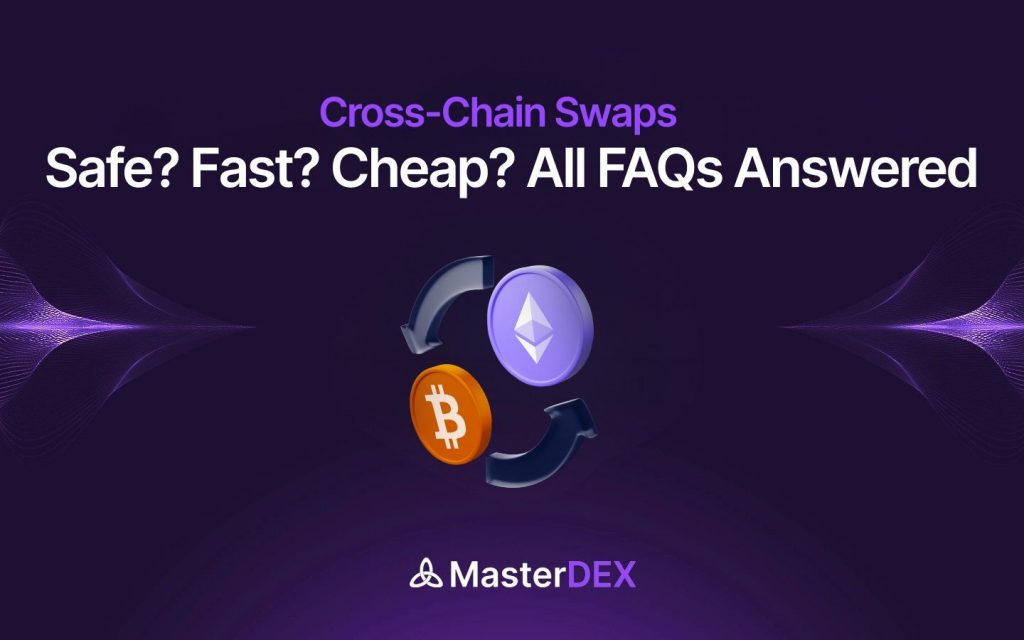
As blockchain ecosystems continue to multiply—Ethereum, BNB Chain, Polygon, Solana, Avalanche, and dozens more—the crypto world has become increasingly fragmented. Cross-chain swaps solve this by enabling seamless asset transfers across different blockchains without needing centralized exchanges or risky manual bridging.
Table of Contents:
Toggle1. What is a cross-chain swap in crypto and why is it important?
A cross-chain swap allows you to exchange one cryptocurrency on a specific blockchain for another cryptocurrency on a different , securely, and without using a centralized exchange. This matters because blockchains are isolated systems. ETH on Ethereum cannot naturally interact with USDC on BNB Chain or SOL on Solana. Cross-chain swaps solve this by enabling direct value transfer across networks, powered by smart contracts or cross-chain routing protocols.
They eliminate the need for custodial exchanges, reduce transfer times, avoid withdrawal fees, and support a smooth multi-chain trading experience. With the growth of DeFi, GameFi, and multi-chain ecosystems, cross-chain swaps have become essential for traders, developers, and everyday crypto users.
2. How does a cross-chain swap technically work step-by-step?
Cross-chain swaps operate through a secure, automated process. Here’s a simplified breakdown:
- You pick the token you want to send and the token you want to receive on another blockchain.
- The swap engine locates the best route using liquidity across multiple chains.
- Your funds are locked, burned, or verified on the source chain.
- Validators or relayers confirm the transaction.
- The equivalent token is released or minted on the destination chain.
Different technologies—like HTLCs, multi-chain liquidity pools, and interoperability protocols ensure the process is trustless and non-custodial. The goal is simple: move value across blockchains with zero reliance on centralized intermediaries.
3. What problem does cross-chain interoperability solve in blockchain networks?
Blockchain networks were built to operate independently, not interact with one another. This leads to problems like:
- Liquidity fragmentation
- High friction for traders
- Multiple wallets and bridges
- Limited utility for multi-chain applications
Cross-chain interoperability removes these barriers by enabling assets to move seamlessly between ecosystems. This expands liquidity, boosts user flexibility, improves DeFi accessibility, and fuels multi-chain innovation. In short, interoperability unlocks a unified crypto world where blockchains can communicate instead of working in silos.
4. What is the difference between a cross-chain swap and a traditional crypto bridge?
A bridge allows you to move an asset from one chain to another, but it creates a wrapped version like moving ETH to BNB Chain as WETH. A cross-chain swap, however, performs a full token exchange across chains (e.g., ETH → BNB).
Key differences:
- Bridges transfer the same asset; swaps exchange it.
- Bridges often rely on custodial lock-and-mint systems, which may involve trust.
- Cross-chain swaps use liquidity pools or routing, making them faster and more flexible.
In short, a bridge is for transferring an asset across chains; a swap is for trading across chains.
5. Are cross-chain swaps safe, and what security mechanisms protect users?
Cross-chain swaps are considered safe when built on proven protocols and smart contracts. Security mechanisms include:
- Non-custodial execution (your funds never leave your wallet until the transaction begins)
- Smart contract audits
- HTLC time-lock protection
- Validator or relayer verification
- Atomic execution (either both sides settle or none settle)
That said, risks come from poorly-designed protocols or low-liquidity routes. Reputable platforms minimize these risks by using audited smart contracts and decentralized infrastructure.
6. What technologies are used in cross-chain swaps (HTLCs, relayers, smart contracts)?
Cross-chain swaps rely on multiple technologies working together:
- HTLCs (Hashed Timelock Contracts) ensure both parties complete the swap or the funds revert.
- Relayers/Validators communicate between chains to confirm events.
- Smart Contracts automate routing and settlement.
- Multi-chain liquidity pools allow swaps to execute instantly.
- Interoperability protocols (IBC, LayerZero, Axelar, etc.) provide secure messaging between chains.
Platforms like MasterDEX combine these technologies to create fast, secure, and efficient cross-chain trading.
7. Which blockchains and networks currently support cross-chain swaps?
Cross-chain swaps today support dozens of major networks, including Ethereum, BNB Chain, Polygon, Arbitrum, Optimism, Avalanche, Solana, Fantom, Base, zkSyn and many more.
Support continues to expand as interoperability improves. Multi-chain DEX aggregators like MasterDEX integrate new networks quickly to ensure users have the broadest access to trading routes.
8. What fees are involved in performing a cross-chain swap?
Cross-chain swaps typically include three main types of fees:
- Network (gas) fees on both the source and destination chain
- Protocol routing fee, which varies by aggregator or platform
- Liquidity provider fee, similar to any DEX swap
The total cost often remains lower than performing multiple manual swaps and bridge transactions. Platforms with smart routing, like MasterDEX, help users find the lowest-fee paths automatically.
9. How long does a cross-chain swap take, and what affects the speed?
A typical cross-chain swap takes anywhere from 5 seconds to several minutes, depending on:
- Network congestion
- Blockchain confirmation speeds
- Routing complexity
- Liquidity availability
- Validator response times
Layer-2 networks like Arbitrum or Base are much faster than older chains like Ethereum. Modern cross-chain routing protocols have dramatically reduced swap times, making them feel nearly instant.
10. Which crypto wallets support cross-chain swaps natively?
Many popular wallets support cross-chain swaps directly or via integrations, including MetaMask, Trust Wallet, Coinbase Wallet, OKX Wallet, Phantom (for multi-chain networks), Rabby Wallet and many others.
Some swaps require wallet extensions or built-in bridges, while others work directly through aggregators like MasterDEX, which connects to any Web3 wallet.
11. Can a cross-chain swap fail, and what happens to your funds if it does?
Cross-chain swaps can fail due to issues like insufficient liquidity, gas spikes, or chain congestion. In such cases, reputable protocols use atomic or conditional logic to automatically:
- Return funds to the sender
- Revert incomplete transactions
- Cancel the swap safely
Your funds should never be stuck or lost as long as the swap provider uses audited contracts and trustless settlement methods.
12. What are the biggest risks of cross-chain swaps, and how can users stay safe?
Common risks include:
- Using unaudited or unsafe platforms
- Liquidity shortages leading to bad pricing
- High gas fees on busy chains
- Fake “swap” websites or phishing attacks
To stay safe, users should:
- Use trusted platforms (e.g., MasterDEX)
- Double-check URLs
- Review token contracts
- Avoid low-liquidity pairs
- Use hardware wallets when possible
Education and due diligence minimize almost all risks.
13. What is an atomic swap, and how is it different from a cross-chain swap?
An atomic swap is a decentralized method of exchanging assets across chains using HTLCs, guaranteeing that either:
- Both trades occur, or
- Neither does
Atomic swaps are fully peer-to-peer and don’t rely on liquidity pools.
Cross-chain swaps, on the other hand, often use liquidity pools or routing systems to create faster, more efficient swaps. They are more user-friendly and flexible but rely on liquidity availability.
Atomic swaps = pure P2P
Cross-chain swaps = liquidity-based, faster, broader support
14. What platforms, DEX aggregators, or tools offer the most reliable cross-chain swaps?
Several platforms provide cross-chain swap capabilities, but the most reliable are multi-chain DEX aggregators that combine liquidity from multiple networks.
MasterDEX is emerging as one of the top choices thanks to:
- Advanced cross-chain routing
- Real-time liquidity aggregation
- Low-fee optimized swap paths
- Fast execution across multiple blockchains
- Clean data and zero noise
Other players include THORChain, LI.FI, and Rango, but the features vary widely. MasterDEX excels in user experience, multi-chain speed, and accurate data feeds.
15. What does the future of cross-chain swaps and multi-chain trading look like?
The future of cross-chain trading is trending toward fully seamless multi-chain interoperability. Expect:
- Faster cross-chain messaging
- Chain-agnostic wallets
- Unified liquidity across ecosystems
- AI-driven routing optimization
- Cheaper, near-instant swaps
- Mass adoption in gaming, DeFi, and real-world tokenization
Platforms like MasterDEX will play a major role as crypto moves toward a fully connected, borderless blockchain environment. The long-term vision: users shouldn’t even need to know which chain they’re on, everything will simply work.
Final Thoughts
Cross-chain swaps represent the future of crypto mobility. As blockchain ecosystems continue to grow, the ability to move assets across chains quickly, safely, and cheaply becomes essential. With secure platforms, strong interoperability protocols, and smart routing tools like MasterDEX, multi-chain trading is more accessible than ever.
Whether you’re a trader, builder, or long-term investor, understanding cross-chain swaps gives you an edge in navigating this multi-chain landscape. And with advanced routing platforms like MasterDEX, accessing seamless, low-fee swaps has never been more secure or user-friendly. The future is multi-chain and cross-chain swaps are the bridge that makes it possible.